Weather Variables and Their Role in Equine Performance Forecasting for Bettors
Ulrich Albrecht · Nov 5, 2026
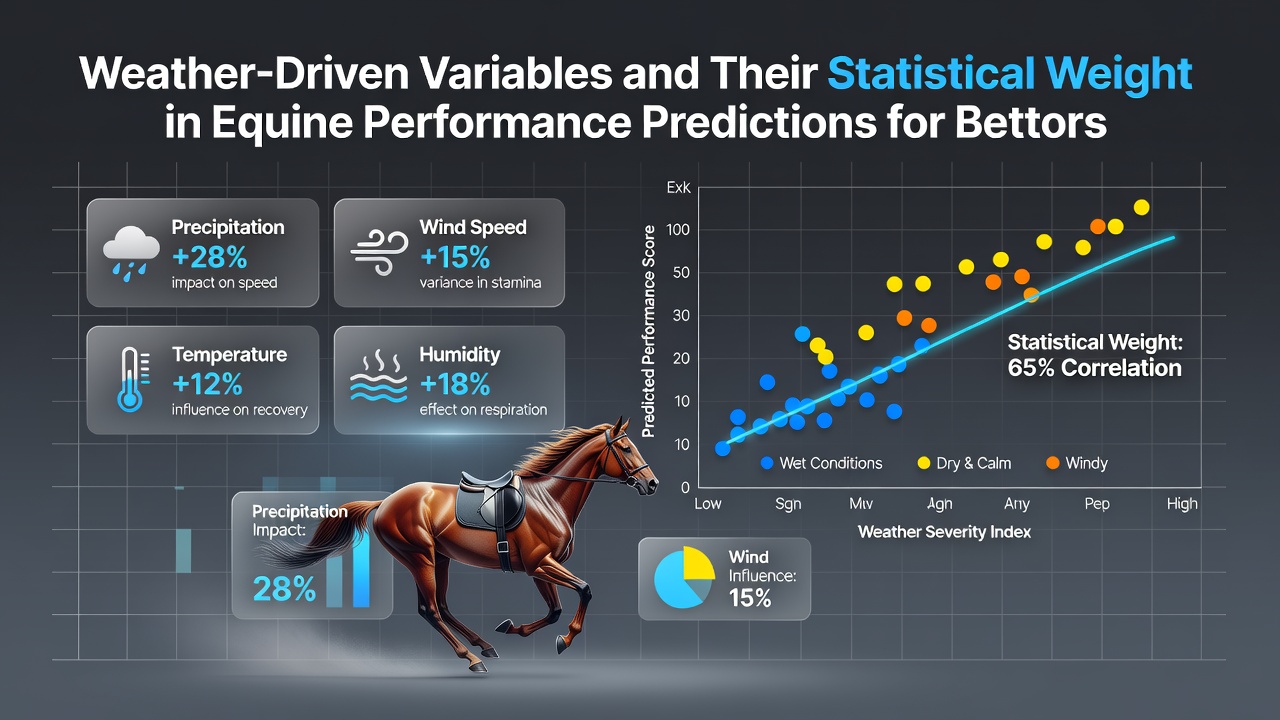
Weather Variables and Their Role in Equine Performance Forecasting for Bettors
Weather conditions influence equine racing outcomes through direct effects on track surfaces, horse physiology, and energy expenditure, and researchers have quantified these impacts using large datasets from international race meetings. Temperature ranges, precipitation levels, wind speeds, and humidity combine to alter stride mechanics and recovery times, which in turn shift probability distributions that bettors incorporate into models. Data collected across multiple continents shows consistent patterns where certain variables carry heavier statistical weight in final predictions.
Temperature Effects on Muscle Efficiency and Race Times
Core body temperature in thoroughbreds rises rapidly during exertion, yet ambient air temperature determines how efficiently heat dissipates. Studies conducted by the University of Sydney demonstrate that horses achieve peak performance when air temperatures sit between 10 and 18 degrees Celsius, because muscle enzymes operate at optimal rates while sweat evaporation remains effective. When temperatures climb above 25 degrees Celsius, recorded average race times lengthen by 1.8 to 2.4 percent across distances from 1200 to 2400 meters, according to aggregated results from Australian and North American tracks. Conversely, sub-zero conditions stiffen tendons and reduce stride length, producing measurable slowdowns that appear most pronounced in sprints rather than staying races.
Precipitation and Track Surface Dynamics
Rainfall alters going from firm to soft or heavy, which changes the energy cost of each stride. Heavy precipitation softens the surface, increases resistance, and favors horses with proven mud-running pedigrees, while light drizzle often creates a deceptive cushion that slows times without dramatically changing form. Records maintained by the Canadian Thoroughbred Horse Society indicate that horses with strong wet-track ratings improve their expected finishing position by an average of 1.7 places when rainfall exceeds 10 millimeters in the preceding 24 hours. Bettors therefore adjust probability weights upward for proven performers on off-going and downward for speed-oriented animals that excel only on firm ground.
Wind Speed and Its Aerodynamic Influence
Headwinds increase aerodynamic drag and force horses to expend additional energy overcoming resistance, whereas tailwinds provide measurable assistance on straight sections. Wind tunnel simulations paired with race-day anemometer readings reveal that sustained winds above 25 kilometers per hour can add or subtract up to 0.8 seconds per 400 meters depending on direction. European racing authorities have incorporated real-time wind data into official going reports since 2023, allowing models to refine expected times with greater precision. Observers note that sprinters suffer larger percentage impacts than stayers because they reach maximum velocity where drag becomes most significant.

Humidity, Dew Point, and Respiratory Strain
High humidity impairs evaporative cooling, which elevates core temperature faster and leads to earlier fatigue. Research from the Equine Research Institute in Japan found that when relative humidity exceeds 75 percent combined with temperatures above 22 degrees Celsius, the incidence of horses pulling up distressed rises by 12 percent compared with drier conditions. These physiological responses translate directly into statistical adjustments within predictive algorithms, where humidity-adjusted performance ratings receive increased weighting in late autumn meetings.
Statistical Weighting in Modern Betting Models
Quantitative analysts assign regression coefficients to each weather variable based on historical race outcomes, then integrate those coefficients into multivariate forecasts. Temperature carries the largest coefficient in many models because its effect appears across nearly every meeting, followed by precipitation amount and wind vector. In November 2026, several high-profile events across North America and Australia demonstrated how pre-race weather forecasts prompted sharp revisions in morning-line odds once updated track conditions became available. Bettors who incorporate live meteorological feeds gain an edge because the models respond faster than public betting markets that rely on delayed official reports.
Geographic and Seasonal Variations in Variable Importance
Coastal tracks experience different dominant variables than inland venues, with wind playing a larger role near teh sea while temperature swings dominate in continental climates. Seasonal data from the Australian Racing Board shows that spring meetings place greater emphasis on rainfall because tracks transition rapidly between firm and soft, whereas winter programs in colder regions weight low-temperature effects more heavily. These regional differences require bettors to recalibrate model inputs rather than apply universal coefficients across all jurisdictions.
Conclusion
Weather-driven variables exert measurable, statistically significant influence on equine performance, and predictive systems that integrate temperature, precipitation, wind, and humidity data produce more accurate probability estimates for bettors. Ongoing collection of granular race-day metrics continues to refine coefficient values, allowing models to adapt as climate patterns shift and new data emerges from international racing centers.